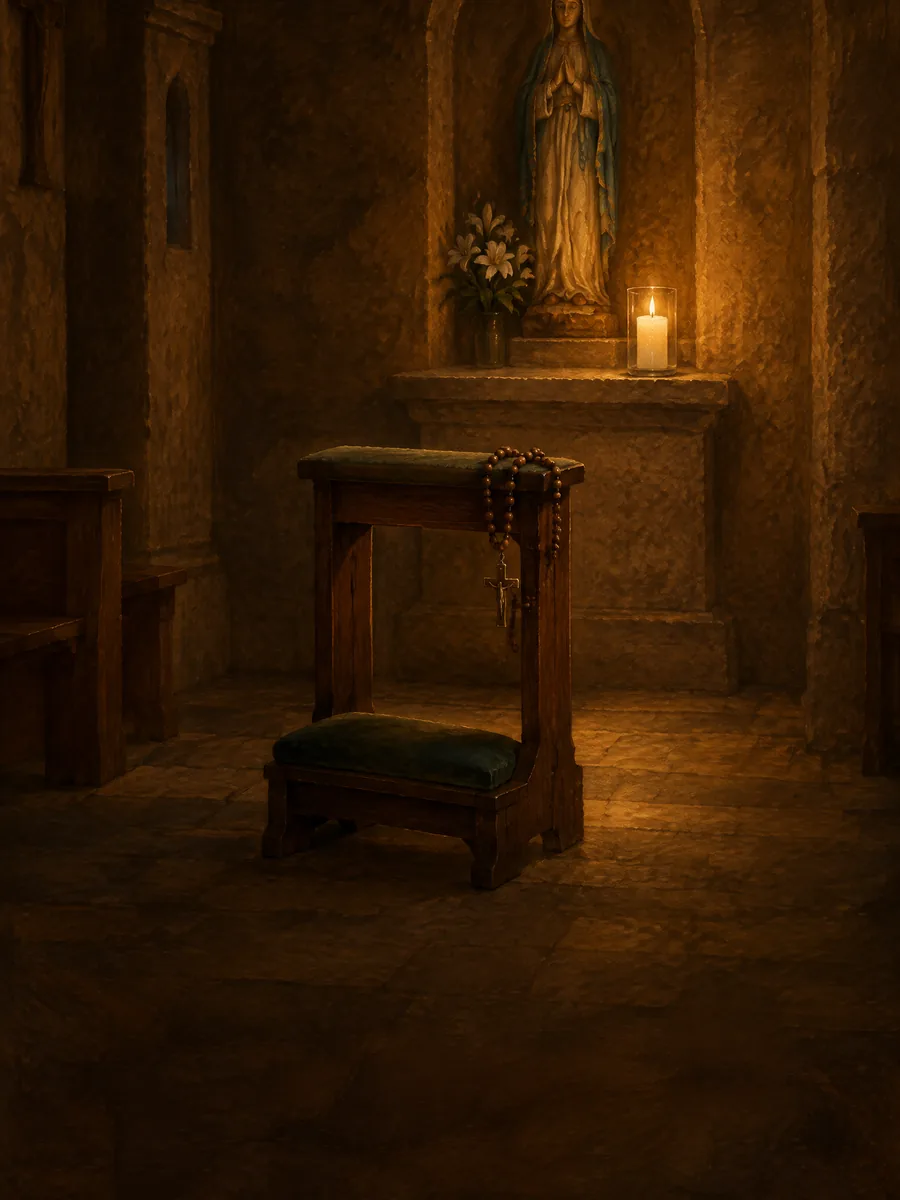
In short
- The Rosary is a Catholic prayer in which you pray the Our Father, Hail Mary, and Glory Be in a set order on the beads while meditating on a scene from the life of Jesus, called a mystery.
- Each decade is one Our Father, ten Hail Marys, and one Glory Be, and a standard Rosary is five decades.
- The mysteries by day are Joyful on Monday and Saturday, Sorrowful on Tuesday and Friday, Glorious on Wednesday and Sunday, and Luminous on Thursday, following Pope John Paul II's Rosarium Virginis Mariae, no. 38.
- The U.S. Conference of Catholic Bishops suggests the Joyful Mysteries on the Sundays of Advent and the Sorrowful Mysteries on the Sundays of Lent.
- The full text of the Rosary prayers in the wording used in U.S. parishes is on the USCCB's How to Pray the Rosary page.
What is the Rosary?
The Rosary is a Catholic prayer in which you move bead by bead through the Our Father, the Hail Mary, and the Glory Be in a set order. While your lips repeat the prayers, your mind stays with one scene from the life of Jesus. Each scene is called a mystery. The prayers for one mystery make up a decade, and a standard Rosary is five decades, one set of five mysteries.
In his 2002 apostolic letter Rosarium Virginis Mariae, Pope John Paul II wrote that to recite the Rosary "is nothing other than to contemplate with Mary the face of Christ." The same letter notes that the first part of the Hail Mary is drawn from the words spoken to Mary by the angel Gabriel and by Elizabeth. You can find both in Luke 1.
The angel appeared to her and said, “Greetings, you who are highly favored! The Lord is with you.”Luke 1:28 (BSB)
In a loud voice she exclaimed, “Blessed are you among women, and blessed is the fruit of your womb!Luke 1:42 (BSB)
Scripture quotations here are from the Berean Standard Bible, which is in the public domain. Catholic Bibles such as the NABRE word these verses differently.
How a rosary is laid out
A rosary is a counting tool. Once you see its shape, the order makes sense.
| Part | How many | Prayer |
|---|---|---|
| Crucifix | 1 | Sign of the Cross, Apostles' Creed |
| First large bead | 1 | Our Father |
| Next small beads | 3 | One Hail Mary each |
| Large bead before each decade | 5 | Our Father |
| Small beads in each decade | 10 × 5 | One Hail Mary each |
Over five decades plus the opening three, you pray 53 Hail Marys in all. No beads with you? Count on your fingers.
How to pray the Rosary step by step
This is the order U.S. parishes commonly use, by prayer name. For the full prayer texts in the wording U.S. Catholics use, see the USCCB's How to Pray the Rosary page.
- Begin: Hold the crucifix, make the Sign of the Cross, and pray the Apostles' Creed.
- First large bead: the Our Father.
- Three small beads: one Hail Mary on each.
- Glory Be: pray the Glory Be. Some people add the short Fatima Prayer ("O my Jesus…") after it.
- First decade: announce the first mystery, for example "The first Joyful Mystery, the Annunciation." Pray the Our Father on the large bead, ten Hail Marys on the small beads, then the Glory Be (and the Fatima Prayer if you use it).
- Decades two to five: move to the next mystery and repeat step 5.
- Close: pray the Hail, Holy Queen and a closing prayer, then make the Sign of the Cross.
The closing prayers vary a little between prayer books, parishes, and groups. When you pray with others, follow the group's pattern. In a group, one person often leads the first half of each prayer and everyone answers with the second half.
Start with an intention
Before you begin, decide who or what you're praying for. When your mind wanders, that intention gives you a place to come back to. Here is an example we wrote for this page.
Example intention
Lord God, I offer this Rosary for my friend who is waiting on test results. As I look at the life of Jesus with Mary, help me hand my worry over to you. Through Christ our Lord. Amen.
The prayers of the Rosary
If the names are new to you, the order is easy to mix up. Here's what each prayer is. You'll find the full texts on the USCCB Rosary page.
| Prayer | When | What it is |
|---|---|---|
| Sign of the Cross | Beginning and end | A short prayer naming the Father, Son, and Holy Spirit as you trace the cross |
| Apostles' Creed | Beginning | A summary of what the Church believes |
| Our Father | Start of each decade | The prayer Jesus taught his disciples (Matthew 6:9-13) |
| Hail Mary | Ten times per decade | A greeting from Luke 1, followed by a request for Mary's prayers |
| Glory Be | End of each decade | A short praise of the Father, Son, and Holy Spirit |
| Fatima Prayer | After the Glory Be (optional) | A short prayer for mercy that some people add to each decade |
| Hail, Holy Queen | Closing | A closing prayer honoring Mary (Salve Regina) |
In Rosarium Virginis Mariae, nos. 32 to 34, John Paul II explains that the Our Father makes even a solitary Rosary a prayer of the Church, that the center of the Hail Mary is the name of Jesus, and that the Glory Be closes each decade in praise. For a closing prayer, no. 37 names the Salve Regina or the Litany of Loreto.
Ten Hail Marys in a row can feel repetitive at first. John Paul II admits as much in no. 26: the repetition can seem dry. He compares it to love returning to the beloved with words similar in content but ever fresh, and writes that the repetition is nourished by the desire to be conformed more completely to Christ. The words stay the same, but the prayer changes as the scene changes.
Rosary mysteries by day
In Rosarium Virginis Mariae, no. 38, John Paul II described the custom at the time (Joyful on Monday and Thursday, Sorrowful on Tuesday and Friday, Glorious on Wednesday, Saturday, and Sunday). He then proposed moving one day of the Joyful Mysteries to Saturday so that Thursday would be free for the new Luminous Mysteries. That is the schedule most people use today.
| Day | Mysteries | What you meditate on |
|---|---|---|
| Monday | Joyful | Jesus' conception, birth, and childhood |
| Tuesday | Sorrowful | Jesus' passion and death |
| Wednesday | Glorious | Resurrection, Ascension, Pentecost, and Mary's glory |
| Thursday | Luminous | Jesus' public ministry |
| Friday | Sorrowful | Jesus' passion and death |
| Saturday | Joyful | Jesus' conception, birth, and childhood |
| Sunday | Glorious | Resurrection, Ascension, Pentecost, and Mary's glory |
The USCCB adds a seasonal note: on the Sundays of Advent, pray the Joyful Mysteries, and on the Sundays of Lent, the Sorrowful Mysteries. In 2026 that covers the four Advent Sundays from November 29 through December 20 (see Advent 2026 dates).
All 20 mysteries with Scripture
We wrote the short titles below for this page. Read the passage once before each decade and the scene will be easier to hold onto.
Joyful Mysteries (Monday, Saturday)
| # | Scene | Scripture |
|---|---|---|
| 1 | The angel tells Mary she will bear Jesus | Luke 1:26-38 |
| 2 | Mary visits Elizabeth | Luke 1:39-56 |
| 3 | Jesus is born in Bethlehem | Luke 2:1-20 |
| 4 | Jesus is presented in the Temple | Luke 2:22-38 |
| 5 | The boy Jesus is found in the Temple | Luke 2:41-52 |
Luminous Mysteries (Thursday)
| # | Scene | Scripture |
|---|---|---|
| 1 | Jesus is baptized in the Jordan | Matthew 3:13-17 |
| 2 | The first sign at the wedding in Cana | John 2:1-11 |
| 3 | Jesus announces the Kingdom and calls for repentance | Mark 1:14-15 |
| 4 | Jesus is transfigured on the mountain | Luke 9:28-36 |
| 5 | Jesus gives the Eucharist at the Last Supper | Luke 22:14-20 |
Sorrowful Mysteries (Tuesday, Friday)
| # | Scene | Scripture |
|---|---|---|
| 1 | Jesus prays in anguish in Gethsemane | Matthew 26:36-46 |
| 2 | Jesus is scourged | John 19:1 |
| 3 | Jesus is crowned with thorns and mocked | Matthew 27:27-31 |
| 4 | Jesus carries the cross to Golgotha | John 19:16-17 |
| 5 | Jesus is crucified and dies | Luke 23:33-46 |
Glorious Mysteries (Wednesday, Sunday)
| # | Scene | Scripture or Church teaching |
|---|---|---|
| 1 | Jesus rises from the tomb | Mark 16:1-8 |
| 2 | Jesus ascends into heaven | Acts 1:6-11 |
| 3 | The Holy Spirit comes on the disciples | Acts 2:1-4 |
| 4 | Mary is taken up into heaven | Catechism of the Catholic Church, 966 |
| 5 | Mary is crowned Queen of heaven | Catechism of the Catholic Church, 966 |
The fourth and fifth Glorious Mysteries are not scenes written in the Bible. They are Church teaching. Catechism no. 966 teaches that when Mary's earthly life was finished, she was taken up body and soul into heavenly glory and exalted by the Lord as Queen over all things. On the Solemnity of the Assumption, the first reading at the Mass during the Day comes from Revelation 12, the woman clothed with the sun.
Tips if you're just starting
- Start with one decade. If five feels like a lot, pray one decade of today's mystery. Short is still the Rosary if you keep the order.
- Stay with one detail. During the ten Hail Marys, rest on one person or one line in the scene. For the Annunciation, Mary's answer, "May it happen to me according to your word," is enough.
- When your mind wanders, come back. Distraction is normal. The moment you notice, return to your intention and the scene.
- Pick a regular time. Your commute, a walk, or the last minutes before bed all work. The same time each day makes it easier to keep going.
Questions
How long does it take to pray the Rosary?
There's no set time. It depends on your pace and how long you stay with each mystery. If you're new, don't time it. Pray one decade slowly, then work up to five.
What mysteries of the Rosary are prayed today?
Monday and Saturday: Joyful. Tuesday and Friday: Sorrowful. Wednesday and Sunday: Glorious. Thursday: Luminous. The USCCB adds that the Sundays of Advent use the Joyful Mysteries and the Sundays of Lent use the Sorrowful Mysteries.
Can I pray the Rosary without rosary beads?
Yes. The beads just help you count. You can count ten Hail Marys on your fingers. What matters is keeping the order of the prayers and staying with the mystery.
When were the Luminous Mysteries added?
Pope John Paul II proposed the five Luminous Mysteries, which focus on Jesus' public ministry, in his 2002 apostolic letter Rosarium Virginis Mariae. The letter says the addition is left to the freedom of individuals and communities.
Where do I find the words to the Hail Mary and the other prayers?
The USCCB's How to Pray the Rosary page lists the prayers in the wording most U.S. Catholics use. We link to it instead of reprinting the texts here.