In short
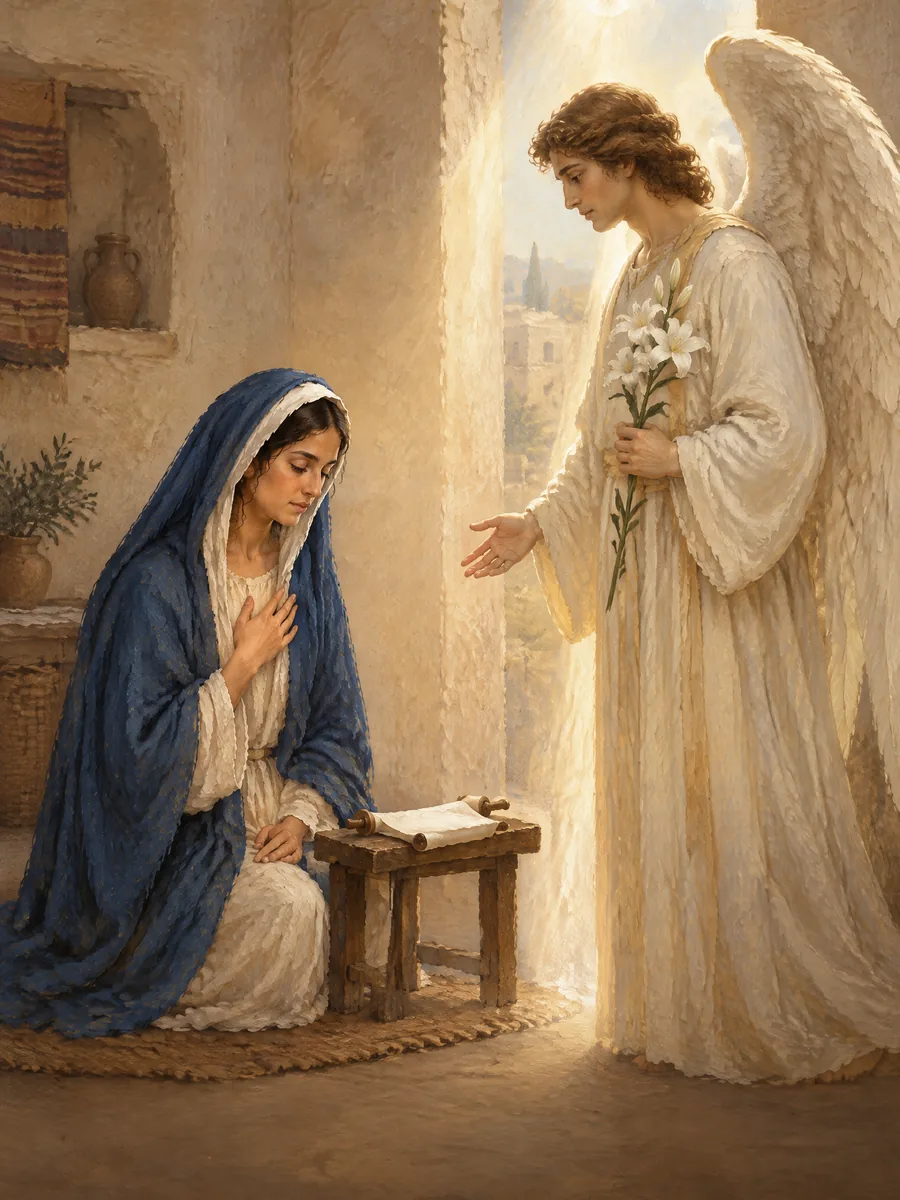
- The Angelus is a Catholic prayer, said three times a day, that recalls the angel Gabriel's announcement to Mary and the Word becoming flesh.
- The Vatican's Directory on Popular Piety says the Angelus is prayed at dawn, midday, and dusk, and the Bishops' Conference of England and Wales gives the times as 6 a.m., noon, and 6 p.m.
- The Angelus has three versicles and responses, each followed by a Hail Mary, then a versicle asking Mary's prayers and a closing prayer.
- During the Easter season, the Regina Caeli replaces the Angelus, by a decision of Pope Benedict XIV in 1742.
- Every Sunday at noon, the Pope prays the Angelus with the faithful in St. Peter's Square and gives a short reflection on the day's Gospel.
What is the Angelus?
The Angelus is a short Catholic prayer, said three times a day, that recalls the angel Gabriel's announcement to Mary and the mystery of the Word becoming flesh. The Vatican's Directory on Popular Piety and the Liturgy (2001), no. 195, calls it "the traditional form used by the faithful to commemorate the holy annunciation of the angel Gabriel to Mary," prayed "at dawn, mid-day and at dusk."
The name comes from the first word of the prayer in Latin, Angelus, which means angel. In many places a church bell, the Angelus bell, rings at those three times. The Directory encourages ringing the bells when the Angelus is prayed solemnly.
In his 1974 apostolic exhortation Marialis Cultus, no. 41, Pope Paul VI wrote that the Angelus "does not need to be revised." He gave his reasons: its simple structure, its biblical character, its link to the prayer for peace and safety, its rhythm that sanctifies different moments of the day, and the way it leads from the Incarnation to the Paschal Mystery. It takes about a minute, but it holds both Christmas and Easter.
The order of the Angelus
The Angelus is three versicles and responses, each followed by a Hail Mary, then a closing prayer. The table shows what each part recalls and where the scene is in Scripture. We don't reprint the prayer text itself (see "Where to find the words" below).
| Part | What it recalls | Scripture |
|---|---|---|
| 1. First versicle and response + Hail Mary | The angel's announcement to Mary, and her conceiving by the Holy Spirit | Luke 1:26-35 |
| 2. Second versicle and response + Hail Mary | Mary calls herself the Lord's servant and accepts God's word | Luke 1:38 |
| 3. Third versicle and response + Hail Mary | The Word became flesh and dwelt among us | John 1:14 |
| 4. Versicle and response asking Mary's prayers | That we may be made worthy of the promises of Christ | — |
| 5. Closing prayer | That we who know the Incarnation be brought through His passion and cross to the glory of His resurrection | — |
In a group, a leader says each versicle and everyone answers with the response. On your own, you say both parts. The Bishops' Conference of England and Wales notes that the Angelus ends with the Glory Be prayed three times.
The Directory, no. 195, says that where the full Angelus is hard to keep up, people should hold on to "at least the recitation of three Aves," that is, three Hail Marys. If you don't know the words yet, three Hail Marys at noon is a good place to start.
When to pray it: morning, noon, and evening
The Directory says dawn, midday, and dusk. The Bishops' Conference of England and Wales gives the times as 6 a.m., noon, and 6 p.m.
- 6 a.m.: as the day begins, before the commute or the first email.
- Noon: a natural pause in the workday. It fits well right before lunch.
- 6 p.m.: as the workday winds down. You can pray it quietly in the car or on the train home.
Paul VI admitted that some customs once tied to the Angelus had disappeared or were hard to keep in modern life. He called those "marginal elements" and said the value of contemplating the Word made flesh stays the same. A steady rhythm of three pauses matters more than hitting the exact minute. A phone alarm set for noon works fine.
During the Easter season: the Regina Caeli
During the Easter season, the Regina Caeli ("Queen of Heaven") is prayed in place of the Angelus. According to the Directory, no. 196, this follows a decision of Pope Benedict XIV on April 2, 1742. The antiphon itself probably dates to the tenth or eleventh century; the Directory notes that it appears in a twelfth-century antiphonary from an abbey in Benevento.
The Regina Caeli calls on Mary to rejoice in her Son's resurrection. The Directory says it joins the mystery of the Incarnation to the Easter event. The Bishops' Conference of England and Wales says it is prayed from Easter to Pentecost and, like the Angelus, ends with the Glory Be three times.
| Year | First day: Easter | Last day: Pentecost |
|---|---|---|
| 2027 | March 28 | May 16 |
The Vatican's 2025 records show the pattern: Pope Leo XIV prayed the Regina Caeli each Sunday through Pentecost on June 8, then the Angelus from June 15.
Where the Angelus comes from in the Bible
The three versicles follow two Gospel scenes. The first two come from the Annunciation in Luke 1. The third comes from the opening of John's Gospel. Reading these passages once before you pray makes the short lines of the Angelus much clearer.
The angel replied, “The Holy Spirit will come upon you, and the power of the Most High will overshadow you. So the Holy One to be born will be called the Son of God.Luke 1:35 (BSB)
“I am the Lord’s servant,” Mary answered. “May it happen to me according to your word.” Then the angel left her.Luke 1:38 (BSB)
The Word became flesh and made His dwelling among us. We have seen His glory, the glory of the one and only Son from the Father, full of grace and truth.John 1:14 (BSB)
Scripture quotations here are from the Berean Standard Bible, which is in the public domain. Catholic Bibles such as the NABRE word these verses differently. The first part of the Hail Mary also comes from Luke 1: the angel's greeting (1:28) and Elizabeth's greeting (1:42).
The Directory suggests that when the Angelus is prayed solemnly, at Marian shrines or in religious communities, the Hail Mary may be sung and the Gospel of the Annunciation proclaimed. On your own, try reading all of Luke 1:26-38 once a week before you pray.
Where the Angelus came from
Paul VI wrote in Marialis Cultus, no. 41, that the Angelus has "its historical origin which links it to the prayer for peace and safety." The Directory, no. 195, says the Angelus is "deeply rooted in the piety of the Christian faithful, and strengthened by the example of the Roman Pontiffs."
We could not confirm from Vatican documents exactly when or by whom the present form was put together. You'll find popular stories with specific dates and names, but this page sticks to what the official documents say: the 1742 rule for the Easter season, and Paul VI's 1974 call to keep the prayer as it is.
The Pope's Sunday Angelus
Every Sunday at noon, the Pope prays the Angelus with the faithful in St. Peter's Square. According to the Bishops' Conference of England and Wales, he first gives a short reflection on the day's Gospel and often speaks about events around the world. His words go out on radio, television, and social media.
The Vatican website keeps these reflections under each pope's "Angelus - Regina Cæli" documents. Besides Sundays, you'll find entries for some feast days, such as the Immaculate Conception on December 8 and St. Stephen on December 26.
Where to find the words
We don't reprint the traditional English text of the Angelus, the Regina Caeli, or the Hail Mary, because we couldn't confirm their copyright status. The USCCB's Angelus page has the wording most U.S. Catholics use. The Bishops' Conference of England and Wales has the Latin and an English version on its Angelus page.
Pray from the text for the first few days. Once you know it, close your eyes at noon and pray it from memory. If you'd like a longer prayer with the Passion, try Stations of the Cross, Step by Step.
Questions
What time is the Angelus prayed?
Three times a day: morning, noon, and evening. The Vatican's Directory on Popular Piety says dawn, midday, and dusk, and the Bishops' Conference of England and Wales gives 6 a.m., noon, and 6 p.m. If you miss the time, pray it when you remember.
What is the order of the Angelus?
A versicle and response, then a Hail Mary, three times over. Then a versicle and response asking Mary's prayers, and a closing prayer. The Bishops' Conference of England and Wales adds the Glory Be three times at the end.
Why is it called the Angelus?
Angelus is Latin for angel, and it is the first word of the prayer in Latin. The prayer begins with the angel Gabriel's announcement to Mary in Luke 1.
When is the Regina Caeli prayed instead?
During the Easter season, from Easter Sunday through Pentecost. In 2027 that's March 28 through May 16.
Where can I find the words of the Angelus?
We don't reprint the traditional English text because we couldn't confirm its copyright status. The USCCB's Angelus page has the wording used in the United States.
Sources
- Directory on Popular Piety and the Liturgy (2001), nos. 195–196 — Holy See
- Pope Paul VI, Marialis Cultus (1974), no. 41 — Holy See
- Catholic Bishops' Conference of England and Wales — The Angelus
- Pope Leo XIV, Angelus - Regina Cæli, 2025 — Holy See
- USCCB — Angelus
- Berean Standard Bible — public domain dedication