
In short
- Good first Bible verses for anxiety are Philippians 4:6-7, Isaiah 41:10, Psalm 4:8 and Matthew 11:28-30.
- For overthinking, read Philippians 4:6-7 and Matthew 6:34; for fear, Isaiah 41:10 and Psalm 56:3; for sleepless nights, Psalm 4:8 and Psalm 121:3-4.
- To pray a verse, pick one, read it slowly two or three times, put your own situation into its words, and say that to God as your prayer.
- Scripture and prayer do not replace medical care: if anxiety does not go away, gets worse, or gets in the way of daily life, talk to a doctor or a licensed mental health professional.
- If you are thinking about harming yourself and you are in the US, call or text 988, or chat at chat.988lifeline.org; if there is immediate physical danger, call 911 first.
Verses to read first when you feel anxious
If you feel anxious right now, find the row in this table that is closest to what you are feeling, and read just that verse. One verse read slowly two or three times does more than ten verses skimmed. Verses are from the Berean Standard Bible unless noted.
| What you're feeling | Read first | In a line |
|---|---|---|
| Overthinking, worry on repeat | Philippians 4:6-7 | Turn worry into prayer with thanksgiving |
| Fear | Isaiah 41:10 | Do not fear, for I am with you |
| Can't sleep | Psalm 4:8 | I will lie down and sleep in peace |
| Worn out | Matthew 11:28-30 | Come to me, all who are weary |
| Heartbroken | Psalm 34:18 | The Lord is near to the brokenhearted |
Below, each situation has three or four verses, with a line or two on where the verse comes from.
When worry keeps looping
Be anxious for nothing, but in everything, by prayer and petition, with thanksgiving, present your requests to God. And the peace of God, which surpasses all understanding, will guard your hearts and your minds in Christ Jesus.Philippians 4:6-7 (BSB)
Paul wrote this letter while in chains (Philippians 1:13). Notice that "be anxious for nothing" doesn't stop there. It moves straight to "present your requests." You are not told to push the worry down. You are invited to say it, piece by piece, to God. And what God's peace guards is your heart and your mind.
Therefore do not worry about tomorrow, for tomorrow will worry about itself. Today has enough trouble of its own.Matthew 6:34 (BSB)
This closes the part of the Sermon on the Mount where Jesus points to the birds of the air and the lilies of the field. One way to read it: sort out what belongs to today and what can wait for tomorrow.
When anxiety overwhelms me, Your consolation delights my soul.Psalm 94:19 (BSB)
The psalmist doesn't describe a trick for shutting off anxious thoughts. He says God's comfort reaches him in the middle of them.
Search me, O God, and know my heart; test me and know my concerns. See if there is any offensive way in me; lead me in the way everlasting.Psalm 139:23-24 (BSB)
A prayer for when you can't sort out your own head. You don't have to untangle everything first. You can ask the One who knows your heart better than you do to look at it with you.
When you are afraid
Do not fear, for I am with you; do not be afraid, for I am your God. I will strengthen you; I will surely help you; I will uphold you with My right hand of righteousness.Isaiah 41:10 (BSB)
This sits within the chapters of Isaiah that begin, "Comfort, comfort My people" (Isaiah 40:1). "Do not fear" comes with a reason attached. It isn't that there is nothing to fear. It's that God is with you.
When I am afraid, I put my trust in You.Psalm 56:3 (BSB)
The psalm's heading places it when the Philistines seized David in Gath. It admits that days of fear will come, and decides ahead of time what to do on those days. It's short enough to memorize.
Even though I walk through the valley of the shadow of death, I will fear no evil, for You are with me; Your rod and Your staff, they comfort me.Psalm 23:4 (BSB)
The valley doesn't disappear. The shepherd walks through it with you. Notice that in this verse the psalmist stops talking about God as "He" and speaks to Him directly: "You are with me."
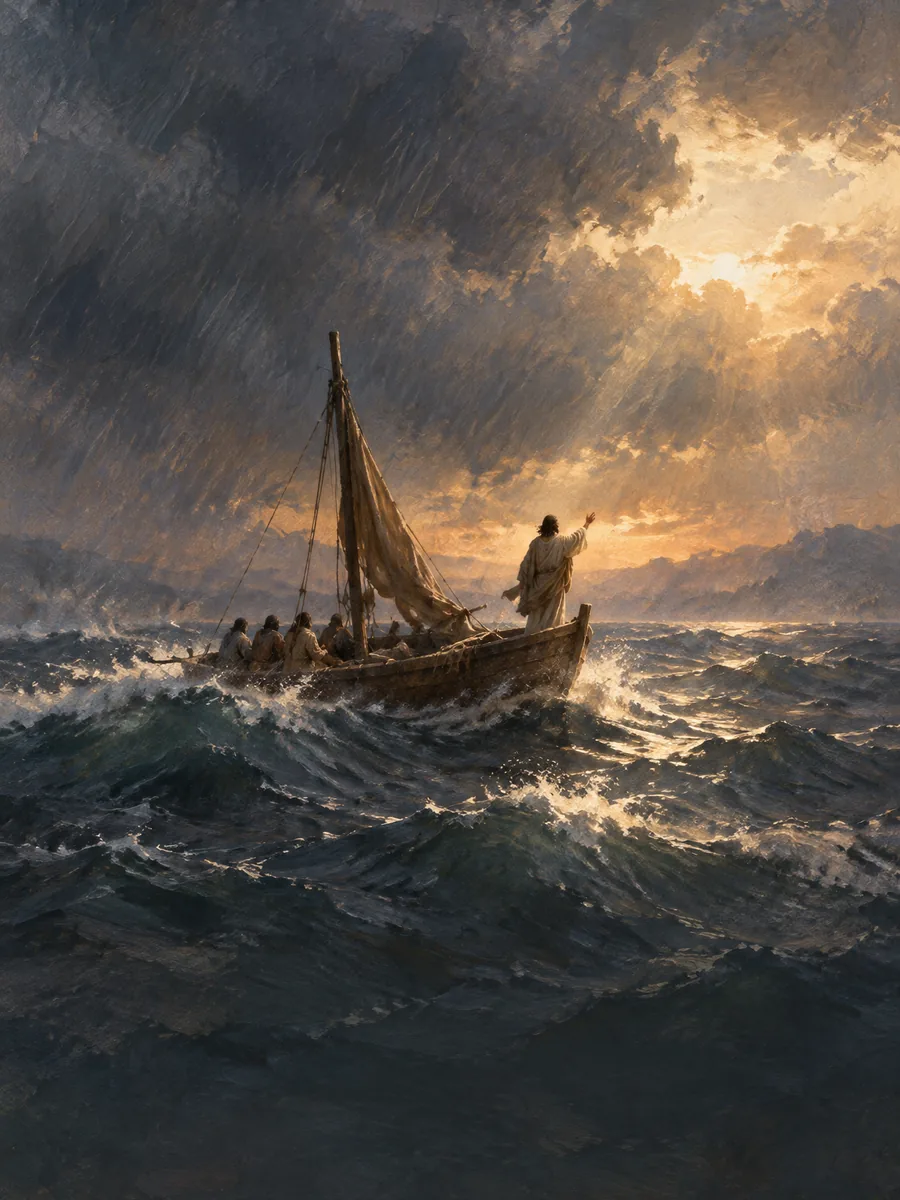
Then Jesus got up and rebuked the wind and the sea. “Silence!” He commanded. “Be still!” And the wind died down, and it was perfectly calm. “Why are you so afraid?” He asked. “Do you still have no faith?”Mark 4:39-40 (BSB)
The disciples, terrified in the storm, woke Jesus up. He did not ignore their cry; He calmed the wind. As you read, keep your eyes on the fact that Jesus was in the same boat the whole time.
On nights you can't sleep
I will lie down and sleep in peace, for You alone, O LORD, make me dwell in safety.Psalm 4:8 (BSB)
In the Catholic Liturgy of the Hours, Psalm 4 is one of the psalms prayed at Night Prayer on Saturday night. It is a way of saying: tonight, keeping me safe is not my job. It is God's.
I lie down and sleep; I wake again, for the LORD sustains me.Psalm 3:5 (BSB)
The heading of Psalm 3 places it when David was fleeing from his son Absalom. Nothing has been resolved, and still he says he lay down, slept and woke.
He will not allow your foot to slip; your Protector will not slumber. Behold, the Protector of Israel will neither slumber nor sleep.Psalm 121:3-4 (BSB)
A song about the One who stays awake while you sleep. When your mind is racing at night, you can simply repeat the last line, slowly.
For a short routine to pray before sleep, see Bedtime prayer: a 5-minute night routine.
When you are worn out
“Come to me, all you who labor and are heavily burdened, and I will give you rest. Take my yoke upon you, and learn from me, for I am gentle and humble in heart; and you will find rest for your souls. For my yoke is easy, and my burden is light.”Matthew 11:28-30 (WEB)
Jesus speaks first and says "come." He doesn't ask you to sort out your burden before you come. He asks you to come with it.
He gives power to the faint and increases the strength of the weak. Even youths grow tired and weary, and young men stumble and fall. But those who wait upon the LORD will renew their strength; they will mount up with wings like eagles; they will run and not grow weary, they will walk and not faint.Isaiah 40:29-31 (BSB)
It begins by admitting that even the young and strong get tired. New strength isn't something you squeeze out of yourself. It is given to those who wait on the Lord.
Cast all your anxiety on Him, because He cares for you.1 Peter 5:7 (BSB)
"All" your anxiety. Small worries count too. The reason given is simple: He cares for you.
When your heart is breaking
The LORD is near to the brokenhearted; He saves the contrite in spirit.Psalm 34:18 (BSB)
When your heart is broken, God can feel far away. This verse says the opposite: that is exactly when He is near.
Why are you downcast, O my soul? Why the unease within me? Put your hope in God, for I will yet praise Him, my Savior and my God.Psalm 42:11 (BSB)
The same question comes back more than once in Psalm 42. The psalmist doesn't shake off his unease in one prayer. He keeps asking his own soul and keeps turning back to God. It is a psalm for when one prayer doesn't settle it.
From the ends of the earth I call out to You whenever my heart is faint. Lead me to the rock that is higher than I.Psalm 61:2 (BSB)
"The ends of the earth" is the place that feels farthest from God, and the psalmist calls out even from there. He asks to be led to a rock he can't climb by himself.
Peace I leave with you; My peace I give to you. I do not give to you as the world gives. Do not let your hearts be troubled; do not be afraid.John 14:27 (BSB)
Jesus said this to His disciples on the night before the cross. It is not peace that comes because things are going well. It is peace He gives.
How to pray with a verse
Reading a verse is a good start. You can go one step further and turn it into your own prayer. If you're new to this, five steps are enough.
- Pick one verse. Choose the one above that is closest to how you feel right now.
- Read it slowly, two or three times. Out loud is fine. Notice the word that catches you.
- Put yourself in it. Where the verse says "you" or "I," put your name and your actual worry.
- Say it to God. Pray the reworded sentence just as it is. It doesn't need to be polished.
- Stay a moment. Sit in silence for about a minute, then read the verse once more and finish.
Example: praying Philippians 4:6-7
These are examples written by the Meloa editorial team. Change them to fit your situation.
God, I can't stop thinking about tomorrow's results, and I can't focus on anything. You told me to bring my requests to you instead of being anxious, so here it is, just as it is. Thank you for getting me through today. I don't understand everything, but let your peace guard my heart and my mind. In Jesus' name, Amen.
Example: praying Psalm 56:3 (Catholic)
Lord God, today is a day of fear. Even if the fear doesn't leave, I want to tell you that I trust in you. Whenever my heart shakes, bring these few words back to me. Through Christ our Lord. Amen.
This page is not a substitute for care
Scripture and prayer are ways for a person of faith to bring an anxious heart before God. They are not a way to diagnose or treat an anxiety disorder, and we are not telling you that prayer will cure anxiety.
The National Institute of Mental Health (NIMH) puts it this way: feeling anxious is a normal part of life, but anxiety disorders involve more than occasional worry or fear. For people with these disorders, anxiety does not go away, shows up in many situations and can get worse over time, and the symptoms can interfere with work, school and relationships.
Consider talking to a doctor or a licensed mental health professional, alongside your prayer, when:
- the anxiety has lasted for weeks or keeps getting worse
- you start avoiding work, school or people because of it
- you often have physical symptoms like a racing heart or shortness of breath (get these checked, since they can have other causes)
- you find yourself leaning on alcohol to quiet it
Getting help and praying are not an either-or choice. If you belong to a church or parish, talking with your pastor or priest can be part of that, too.
Where to get help
| When | Where | Details |
|---|---|---|
| You are thinking about suicide or harming yourself, or you are in emotional crisis (US) | Call or text 988, or chat at chat.988lifeline.org | The 988 Suicide & Crisis Lifeline is free, confidential and available 24/7, in English and Spanish. |
| There is an immediate physical danger (US) | 911 | 988 asks you to call 911 first in this case. |
| You are outside the US | Your local emergency number | Call it right away if you or someone else is in danger. |
We checked these details in November 2026 on the 988 Lifeline's Get Help page and terms of service. For more on anxiety itself, see NIMH: Anxiety Disorders.
Questions
What is the best Bible verse for anxiety?
There is no single right verse, but the ones people reach for most are Philippians 4:6-7 (bring your requests to God with thanksgiving), Isaiah 41:10 (do not fear, for I am with you), Psalm 4:8 (I will lie down and sleep in peace) and Matthew 11:28-30 (come to me, all who are weary). Pick the group below that matches how you feel and read just one verse slowly.
Does feeling anxious mean I lack faith?
Scripture is full of people who brought their fear and unease straight to God. In Psalm 42:11 the psalmist asks, "Why the unease within me?" Feeling anxious and praying about it can go together. If anxiety lasts or starts to run your life, don't treat it only as a spiritual problem. Get professional help as well.
Will praying make my anxiety go away?
We don't promise that. Prayer and Scripture are ways to bring your heart before God; they are not a treatment for an anxiety disorder. The National Institute of Mental Health notes that with anxiety disorders, anxiety does not go away and can interfere with daily life, and it points readers to ways to find help.
Which Bible translation is used here?
Most verses are from the Berean Standard Bible (BSB), and one is from the World English Bible (WEB). Both are in the public domain. Catholic readers can look up the same references in their own Bible. In the Psalms, verse numbers can differ by one in some Catholic editions.
What verses help when anxiety keeps me awake?
Psalm 4:8, Psalm 3:5 and Psalm 121:3-4 all picture lying down, sleeping and being kept by God. If you have trouble sleeping night after night, talk to a doctor. This page is not sleep advice.
Sources
- National Institute of Mental Health — Anxiety Disorders
- 988 Suicide & Crisis Lifeline — Get Help
- 988 Suicide & Crisis Lifeline — FAQ (languages, text hours)
- 988 Suicide & Crisis Lifeline — Terms of Service (call 911 first)
- Berean Standard Bible — public domain dedication
- World English Bible — copyright statement